2024-ongoing
Funding agency: Technion Sustainability Frontier
Researchers: Or Aleksandrowicz, Sagi Dalyot, Gil Revivo, Chen Algavish
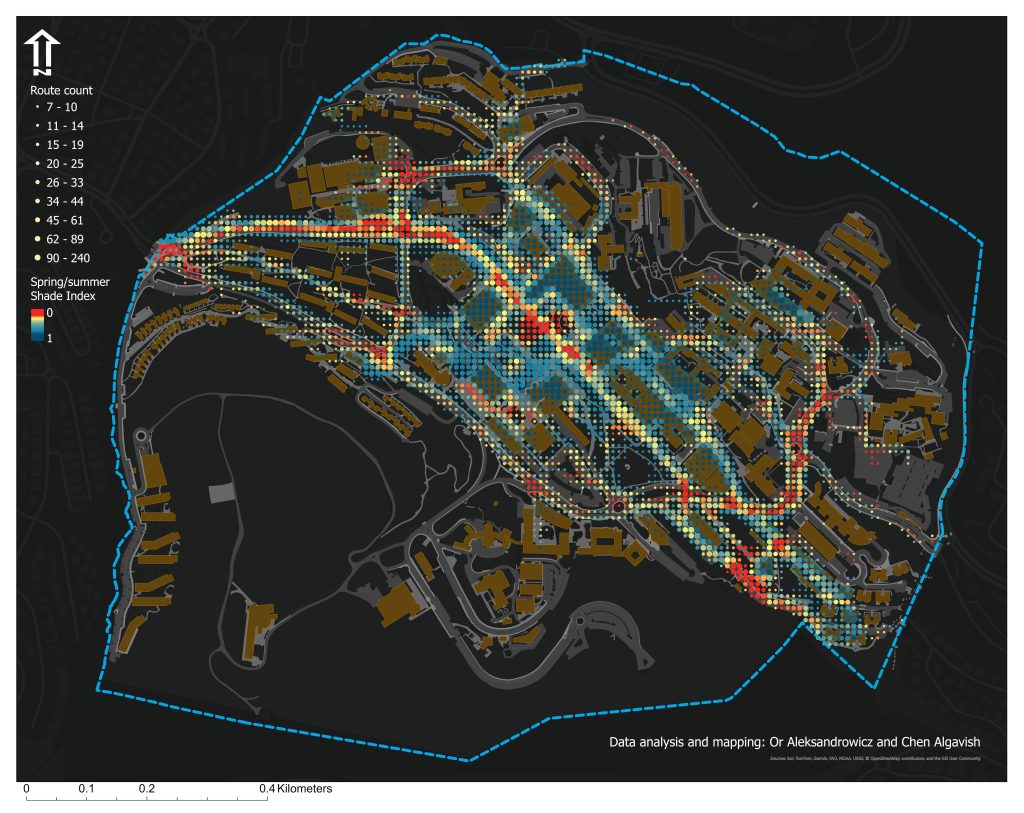
This study aims to quantify the negative effects of solar exposure and steep topography on walking preferences and to develop a predictive model to estimate increases in pedestrian traffic resulting from improvements in shade provision. In this study, we aim to conduct a systematic monitoring of pedestrian flows at the Technion campus during the hot season. Monitoring will be done using mixed data collection methods: walking trajectories from GPS observations from a smartphone app installed by volunteers and anonymized pedestrian entry records from the Technion’s main gates.
The pedestrian data will be supplemented with GIS data for shade mapping of all pedestrian routes on the campus, highlighting poorly shaded paths, and for topographic mapping of the campus, quantifying the steepness of pedestrian routes. By combining the pedestrian and physical environmental data, we will be able to identify daily and seasonal trends of pedestrian flow, map the main pedestrian routes around the campus, and relate them to shade provision and topographic features.
The study is expected to provide an evidence-based analysis of pedestrian behaviour on the Technion campus, while identifying possible impediments to increasing walking on campus. At the same time, the study will serve as a basis for developing a model to quantify the effects of a lack of shade and steep topography on pedestrian flows. The opportunity to use the Technion campus as a living lab for exploring the study’s underlying assumptions will support the development of a comprehensive model based on more extensive datasets.